In the previous article of the series “VMwareTraining. Year 2023″ we considered a list of training programs in the direction of Virtual Cloud Network: VMware SD-WAN.
Today we will talk about the main training programs in the field Virtual Cloud Network: vRealize Network Insight.
vRealize Network Insight
vRealize Network Insight is a network monitoring tool that helps you build an optimized, highly available and secure network infrastructure across your cloud environments including NSX, VMware SD-WAN, vSphere, VMware Cloud on AWS and Kubernetes deployments.
Key current VMware vRealize Network Insight technology training programs are:
Target audience: Network professionals and who design, build, operate, manage, and troubleshoot software-defined networking and security, and application owners who need visibility across multi-cloud environments.
Prerequisites: Students taking this course should have general networking concepts including TCP/IP service and protocols, security knowledge and familiar with NSX architecture.
Before taking this course, students are recommended to take the following courses or have equivalent knowledge and experience:
VMware NSX-T Data Center: Install, Configure, Manage.
This two-day, hands-on course gives you the skills to deploy and use VMware vRealize Network Insight to ensure an optimized, highly available, and secure infrastructure for your applications. You will learn the features, components, architecture, and benefits of vRealize Network Insight and how to use it to simplify daily operation and troubleshooting tasks.
WARNING! This course was removed from the catalog, and replaced by the following course: VMware Aria Operations for Networks: Install, Configure, Manage.
The courses of the VMware Aria direction will be considered in one of the following publications of this cycle.
Brief Summary
In this article, we got acquainted with the main training programs in the field of Virtual Cloud Network: VMware vRealize Network Insight.
In the next publication of the cycle “VMwareTraining. Year 2023″ we will talk about training programs in the field of Virtual Cloud Network: VMware HCX.
Follow the news until the meeting is on air in a few days. Sincerely, AIRRA.
Hello to all readers of the SDDC and Architecture, Solution, Implementation and Operations as Code blog.
Today we will talk about such a conceptual approach as Operations as Code, which is an integral part of the Anything as Code: strategy. I, as an Architect and Engineer in the field of cloud technologies, have been trying to adhere to this strategy as much as possible for the last ten years.
Today I want to share with you my small developments, which fit nicely into the Operation as Code approach.
Probably, we all constantly face the situation when we need to upload some file to the VMware Virtual Infrastructure Datastore, for example, the installation image of the operating system in order to mount it to the virtual machine.
I wrote a small Powershell function that performs the task of uploading a file to the ESXi datastore. Functions are passed to the input the necessary parameters in the form of a variable, changing which you can also use a code reuse strategy.
Upload-FileToDatastore
So let’s look at the code for the Upload-FileToDatastore function:
Function Upload-FileToDatastore {

<#
.SYNOPSIS
    Upload file to ESXi datastore.

.DESCRIPTION
    Silent deploy the specified file to ESXi datastore.

.PARAMETER Target
    Name or IP Address of the VMware ESXi.

.PARAMETER Path
    Path to source file.

.PARAMETER Source
    Name of source file.

.PARAMETER Datastore
    Name of destination ESXi Datastore.

.PARAMETER Folder
    Name of destination ESXi Datastore Folder.

.NOTES
    Version:        0.1
    Author:         Andrii Romanenko
    Website:        blogs.airra.net
    Creation Date:  12.05.2022
    Purpose/Change: Initial script development

    Version:        0.2
    Author:         Andrii Romanenko
    Change Date:    28.09.2022
    Purpose/Change: Add Work Time Measuring.

    Version:        0.3
    Author:         Andrii Romanenko
    Change Date:    30.12.2023
    Purpose/Change: Reorganize Function. Add Workflow Time Measuring External Function: Get-CalculateWorkingTime.

.EXAMPLE

    $Parameters = @{
        Target    = $ESXiHost
        Path      = "c:\!\"
        Source    = "en_windows_server_2019_x64_dvd_4cb967d8.iso"
        Datastore = $ISODatastore
        Folder    = "\ISO"
    }
    Upload-FileToDatastore @Parameters
#>

param (
    [Parameter(Mandatory)][string]$Target,
    [Parameter(Mandatory)][string]$Path,
    [Parameter(Mandatory)][string]$Source,
    [Parameter(Mandatory)][string]$Datastore,
    [Parameter(Mandatory)][string]$Folder
)

# Get start time of the Upload ISO operation
$StartTime = Get-Date
$Message = "Begin Upload: "  + $Source + " to Datastore: " + $Datastore + " on Target:" + $Target + "."
Write-Host -ForegroundColor Green $Message

# Upload ISO
$ds = Get-VMHost -Name $Target | Get-Datastore $Datastore
New-PSDrive -Location $ds -Name DS -PSProvider VimDatastore -Root "\" > $null
Copy-DatastoreItem -Item $Path$Source -Destination "DS:/$($Folder)"
Remove-PSDrive -Name DS -Confirm:$false

Write-Host -ForegroundColor Green "Upload Finished!"

# Get end time of the Upload ISO operation
$EndTime = Get-Date

# Calculate Elapsed Time of the operation
Get-CalculateWorkingTime -StartTime $StartTime -EndTime $EndTime
}
The function accepts the following mandatory parameters as input in the form of the @Parameters variable:
Target – Name or IP Address of the VMware ESXi;
Path – Path to source file;
Source – Name of source file;
Datastore – Name of destination ESXi Datastore;
Folder – Name of destination ESXi Datastore Folder.
At the beginning of work, the start time is fixed in the form of the $StartTime variable.
Next, the Datastore parameters of the ESXi Host are entered into the $ds variable.
To access the Datastore for the copy operation, the standard New-PSDrive Powershell commandlet is used. The copy operation is performed by the Copy-DatastoreItem command from VMware PowerCLI.
At the end of the operation, the PSDdrive object is deleted and the copying $EndTime is fixed.
The calculation of the duration of the copying operation is carried out by calling the external function Get-CalculateWorkingTime, which receives the parameters of the start and end of the operation.
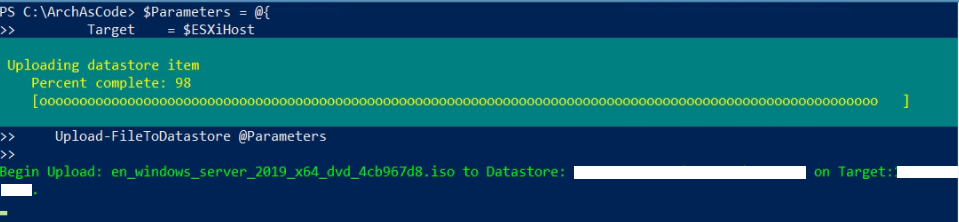
The result of the function is shown in the following figure:
Figure 1. The result of the execution of the Upload-FileToDatastore Powershell function.
Get-CalculateWorkingTime
The code for the Get-CalculateWorkingTime function is below.
Function Get-CalculateWorkingTime {

<#
.SYNOPSIS
    Calculate working time of workflow.

.DESCRIPTION
    Calculate working time of workflow.

.PARAMETER StartTime
    Begin Time of Workflow.

.PARAMETER EndTime
    End Time of Workflow.

.NOTES
    Version:        0.1
    Author:         Andrii Romanenko
    Website:        blogs.airra.net
    Creation Date:  22.03.2023
    Purpose/Change: Initial script development

    Version:        0.2
    Author:         Andrii Romanenko
    Website:        blogs.airra.net
    Creation Date:  14.08.2023
    Purpose/Change: Add time measuring format in hours.

.EXAMPLE

    Get-CalculateWorkingTime -StartTime $StartTime -EndTime $EndTime

#>

param (
    [Parameter(Mandatory)][datetime]$StartTime,
    [Parameter(Mandatory)][datetime]$EndTime
)

# Calculate Elapsed Time of the workflow operation
$ElapsedTime = $EndTime-$StartTime
$ElapsedTime = '{0:hh} h. {0:mm} min. {0:ss} sec.' -f $ElapsedTime
Write-Host 'Total Operation Duration:'  $ElapsedTime -ForegroundColor Green
}
Brief Summary
So, in today’s post, I’ve shared with you some code snippets that demonstrate the strategy and practice of Operations as Code.
I note that you can use this code at your discretion, adding there, for example, verification codes and handling of exceptional situations, such as whether there is a connection to the ESXi host or a file with the same name is present, etc.
Also, don’t forget that the function requires the presence of the VMware PowerCLI.
That’s all for today. But in the next publication, I will tell about the function that will help check the already copied file on the datastore for the checksum.
Follow the news until the meeting is on air in a few days. Sincerely, AIRRA.
In the previous article of the series “VMwareTraining. Year 2023″ we considered a list of training programs in the direction of VMware NSX Advanced Load Balancer.
Today we will talk about the main training programs in the field Virtual Cloud Network: VMware SD-WAN.
VMware SD-WAN
SD-WAN is the application of software based network technologies that virtualize WAN connections. SD-WAN decouples network software services from underlying hardware to create a virtualized network overlay.
Key current VMware SD-WAN technology training programs are:
Experienced system administrators, network administrators, and system integrators responsible for designing and implementing networking solutions;
Network and security professionals who work with enterprise and data center networks.
Prerequisites: Extensive knowledge of routing and switching is required.
You should also have the following understanding or knowledge:
Good understanding of TCP/IP services and protocols;
Knowledge and working experience of computer networking, including:
Switching and routing technologies (L2-L3);
Network and application delivery services (L4-L7);
Basic understanding of IaaS, SaaS, and public and private cloud.
The VMware Certified Professional – Network Virtualization (2020) certification is recommended.
This two-day, hands-on training course provides you with the knowledge, skills, and tools to achieve competency in deploying and managing the VMware SD-WAN by VeloCloud environment. In this course, you are introduced to workflows of various software-defined WAN constructs along with several operational tools that help you deploy and manage VMware SD-WAN by VeloCloud.
● VMware SD-WAN by VeloCloud: Design and Deploy [V3.x]
Duration: 3 days.
Level of difficulty: Advanced (L400+).
Target audience: Any Managed Service Provider who is designing VMware SD-WAN solutions or managing SD-WAN networks for their customers.
Prerequisites:
Deep understanding of routing and switching technologies;
Deep understanding of security solutions, including VPN technologies;
Completion of the VMware SD-WAN VTSP Accreditation;
Completion of the VMware SD-WAN by VeloCloud: Deploy and Manage course.
Customers demand a scalable, secure, and manageable VMware SD-WAN by VeloCloud. To deliver a successful solution you must understand VMware SD-WAN architecture, know how the features can solve customer use cases, and be able to design a VMware SD-WAN that can be easily deployed, managed, and expanded.
Service providers who are designing or using VMware SD-WAN solutions or managing SD-WAN networks for customers;
Service providers looking to deliver a managed hybrid WAN with MPLS service;
Service providers transforming their MPLS networks for direct access to cloud services and increased network agility.
Prerequisites: Before taking this course, you should have completed the following course:
VMware SD-WAN: Deploy and Manage;
You should also have the following understanding or knowledge:
Good understanding of SD-WAN architectures;
Experience of operating Linux servers, especially Ubuntu;
Knowledge and working experience of computer networking;
Experience with routing and switching technologies;
Experience with security solutions, including VPN technologies.
The VMware SD-WAN VTSP accreditation is recommended.
This three-day, hands-on training course provides you with the advanced knowledge, skills, and tools to achieve competency in operating and troubleshooting the VMware SD-WAN™ environment for service providers.
In this course, you focus on deploying and managing VMware SD-WAN for a service provider, including troubleshooting common issues.
Brief Summary
In this article, we got acquainted with the main training programs in the field of Virtual Cloud Network: SD-WAN.
In the next publication of the cycle “VMwareTraining. Year 2023″ we will talk about training programs in the field of Virtual Cloud Network: vRealize Network Insight.
Follow the news until the meeting is on air in a few days. Sincerely, AIRRA.
In the previous article of the series “VMwareTraining. Year 2023″ we considered a list of training programs in the direction of Virtual Cloud Network: VMware NSX.
Today we will talk about the main training programs in the field Virtual Cloud Network: VMwareNSX Advanced Load Balancer.
VMware NSX Advanced Load Balancer
VMware NSX Advanced Load Balancer is designed to work for different scenarios. It can provide a platform for multi-cloud environments to offer a single management console to deal with the various environments. Web application security is delivered as a critical component of the solution to protect the applications and data.
Key current VMware NSX Advanced Load Balancer technology training programs are:
Target audience: Experienced system administrators and network administrators.
This five-day, fast-paced course provides comprehensive training to install, configure, and manage a VMware NSX Advanced Load Balancer (Avi Networks) solution. This course covers key NSX Advanced Load Balancer (Avi Networks) features and functionality offered in the NSX Advanced Load Balancer 20.x release. Features include the overall infrastructure, virtual services and application components, global server load balancing, various cloud connectors, application troubleshooting, and solution monitoring. Hands-on labs provide access to a software-defined data center environment to reinforce the skills and concepts presented in the course.
Target audience: Experienced system administrators and network administrators.
Prerequisites: This course has no prerequisites.
This five-day, fast-paced course provides comprehensive training to install, configure, and manage a VMware NSX Advanced Load Balancer (Avi Networks) solution. This course covers key NSX Advanced Load Balancer (Avi Networks) features and functionality offered in the NSX Advanced Load Balancer 21.x release. Features include the overall infrastructure, virtual services, application components, global server load balancing, various cloud connectors, application troubleshooting, and solution monitoring. Hands-on labs provide access to a software-defined data center environment to reinforce the skills and concepts presented in the course.
Experienced system administrators or network administrators and security professionals.
This three-day course provides comprehensive training on how to configure, maintain and troubleshoot the Web Application Firewall component of the VMware NSX Advanced Load Balancer (Avi Networks) solution as well as provide an understanding of additional security related functionality. This course covers key NSX Advanced Load Balancer (Avi Networks) Web Application Firewall features and functionality offered in the NSX Advanced Load Balancer 18.2 release, including the overall infrastructure, virtual services and application components as well as application troubleshooting and solution monitoring. Access to a software-defined data center environment is provided through hands-on labs to reinforce the skills and concepts presented in the course.
Experienced system administrators and network administrators.
Prerequisites:
Good experience in networking and load balancing concepts;
Basic understanding of web technologies such as html, JavaScript, HTTP request-response, REST API.
This three-day course provides comprehensive training to install, configure, and manage a VMware NSX Advanced Load Balancer Web Application Firewall (WAF) solution. This course covers key NSX Advanced Load Balancer WAF features and functionality offered in the NSX Advanced Load Balancer 22.1.3 release for web security and application attack protection. Features include security pipeline, application learning, policy tuning, false positive mitigation, virtual patching, threat intelligence, troubleshooting, logs, analytics, and solution monitoring. Hands-on labs provide access to an NSX Advanced Load Balancer environment to reinforce the skills and concepts presented in the course.
● VMware NSX Advanced Load Balancer: Install, Configure, Manage plus Troubleshooting and Operations Fast Track [V20.x]
Duration: 5 days.
Level of difficulty: Advanced (L400+), Intermediate (L300).
Target audience:
Experienced system administrators or network administrators;
Network professionals who have experience working with NSX Advanced Load Balancer and are responsible for troubleshooting and operating Application Delivery Controllers solutions.
This five-day, extended hour course introduces you to advanced VMware NSX Advanced Load Balancer (Avi) solutions management skills. In this course, you will learn to install, configure, and manage a VMware NSX Advanced Load Balancer solution. Also, you will learn advanced knowledge, skills, and tools to achieve competence in operating and troubleshooting the NSX Advanced Load Balancer solutions.
This course covers key NSX Advanced Load Balancer features, functionality and troubleshooting tools offered in the NSX Advanced Load Balancer 20.x release. Features include the overall infrastructure, virtual services and application components, global server load balancing, various cloud connectors, application troubleshooting, and solution monitoring.
The course includes troubleshooting hands-on labs, in which you will be presented with various types of technical problems. You will identify, analyze, and solve the technical problems through a systematic process.
Brief Summary
In this article, we got acquainted with the main training programs in the field of Virtual Cloud Network: VMwareNSX Advanced Load Balancer.
In the next publication of the cycle “VMwareTraining. Year 2023″ we will talk about training programs in the field of Virtual Cloud Network: VMware SD-WAN.
Follow the news until the meeting is on air in a few days. Sincerely, AIRRA.
In the previous article of the series “VMwareTraining. Year 2023″ we considered a list of training programs in the direction of Virtual Cloud Network: VMware NSX-T Data Center.
Today we will talk about the main training programs in the field Virtual Cloud Network: VMware NSX.
VMware NSX
VMware NSX-T Data Center is the network virtualization and security platform that enables the virtual cloud network, a software-defined approach to networking that extends across data centers, clouds, and application frameworks.
VMware has updated the product name for the VMware NSX-T data center to VMware NSX. This change better reflects the capabilities and benefits the product brings to customers.
The main current training programs for VMware NSX technologies are:
VMware Data Center Virtualization: Core Technical Skills;
Kubernetes Fundamentals.
This five-day, fast-paced course provides comprehensive training to install, configure, and manage a VMware NSX environment. This course covers key features and functionality offered in the NSX 4.0.0.1 and NSX 4.0.1 releases, including the overall infrastructure, logical switching, logical routing, networking and security services, firewalls and advanced threat prevention, and more.
● VMware NSX: Troubleshooting and Operations [V4.x]
Duration: 5 days.
Level of difficulty: Advanced (L400+).
Target audience:
Experienced system administrators and network administrators;
Network and security professionals who work with enterprise networks.
Prerequisites: Before taking this course, you must complete the following course:
VMware NSX: Install, Configure, Manage [V4.0].
You should also have understanding or knowledge of these technologies:
Good understanding of TCP/IP services and protocols;
Knowledge and working experience of computer networking and security, including:
Switching and routing technologies (L2 andL3);
Network and application delivery services (L4 through L7);
Firewalling (L4 through L7);
VMware vSphere environments.
The VMware Certified Professional – Network Virtualization certification is recommended.
This five-day, hands-on training course provides the advanced knowledge, skills, and tools to achieve competency in operating and troubleshooting the VMware NSX infrastructure. This course introduces you to workflows of various networking and security constructs along with several operational and troubleshooting tools that help you manage and troubleshoot your VMware NSX environment.
In addition, various types of technical problems are presented to you, which you will identify, analyze, and solve through a systematic process.
Target audience: Network and security architects and consultants who design the enterprise and data center networks and NSX environments.
Prerequisites:
Before taking this course, you must complete the following course:
VMware NSX-T Data Center: Install, Configure, Manage [V4.0].
You should also have the understanding or knowledge of these technologies:
Good understanding of TCP/IP services and protocols;
Knowledge and working experience of computer networking and security, including:
Switching and routing technologies (L2-L3);
Network and application delivery services (L4-L7);
Firewalling (L4-L7);
vSphere environments.
The VMware Certified Professional – Network Virtualization certification is recommended.
This five-day course provides comprehensive training on considerations and practices to design a VMware NSX environment as part of a software-defined data center strategy. This course prepares the student with the skills to lead the design of an NSX environment, including design principles, processes, and frameworks. The student gains a deeper understanding of the NSX architecture and how it can be used to create solutions to address the customer’s business needs.
Prerequisites: You should also have the following understanding or knowledge:
Good understanding of TCP/IP services and protocols;
Knowledge and working experience of network security, including:
L2 through L7 firewalling;
Intrusion detection and prevention systems;
Malware prevention systems;
Knowledge of and working experience with VMware vSphere® environments.
The VMware Certified Technical Associate – Network Virtualization is recommended.
This five-day, hands-on training course provides you with the knowledge, skills, and tools to achieve competency in configuring, operating, and troubleshooting VMware NSX for intrinsic security. This course introduces all the security features in NSX, including Distributed Firewall and Gateway Firewall, Intrusion Detection and Prevention (IDS/IPS), NSX Application Platform, NSX Malware Prevention, VMware NSX Intelligence, and VMware NSX NDR. In addition, this course presents common configuration issues and gives a methodology to resolve them.
Brief Summary
In this article, we got acquainted with the main training programs in the field of Virtual Cloud Network: VMware NSX.
In the next publication of the cycle “VMwareTraining. Year 2023″ we will talk about training programs in the field of Virtual Cloud Network: NSX Advanced Load Balancer.
Follow the news until the meeting is on air in a few days. Sincerely, AIRRA.